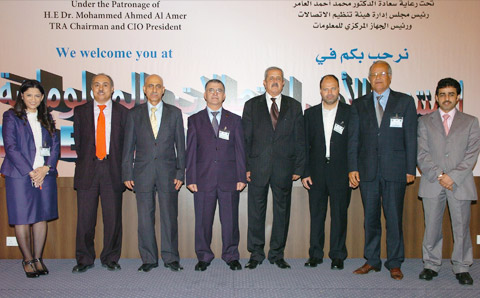
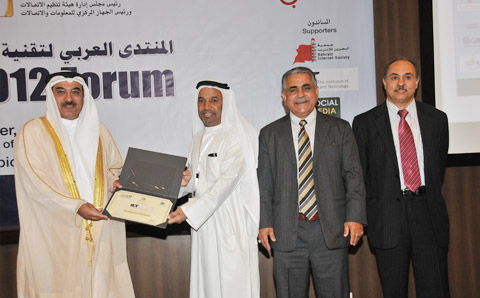
Arab ICT 2012 Forum - 1st and 2nd October, 2012
| Speaker | Title of Presentation | |
|
Dr. Abdelfattah ABUQAYYAS ICT Consultant | CITC- Kingdom of Saudi Arabia |
Main ICT Indicators in Arab Countries The main ICT indicators will be benchmarked between Arab Countries and Globally. Such indicators will include the key complex ICT Indices ones such as - ICT development Index by ITU - Network Readiness Index - E- Government Index by UN - E-Readiness Ranking by the Economic Intelligence Unit (EIU) and IBM
|
| Dr. Jassim Haji Director of Information Technology |
‘How Gulf Air transitioned to the Cloud and achieved business performance and enhanced customer service’ Gulf Air was one of the first airlines to go to the cloud. It has successfully moved its 170 interlinked legacy applications onto a private cloud, but whilst it has reduced both existing IT and management costs and helped the company avoid some previously inevitable future costs, the biggest driver of the program and where the biggest benefits have come were in “being able to meet the demands of the rapid growth of the business.” |
|
Mrs Nefertiti Ali Senior Advisor for Arab States ; ITU Arab Regional Office |
The role of ITU in development of ICT sector in Arab region This speech will focus on:
|
![]() | Jeremy Foster Head of Marketing, Government and Industry Relations - Ericsson Region Middle east |
'Today's Cloud, Same Same or Different?' This presentation discusses private networks versus private clouds, hybrid clouds and cloud bursting, economics behind cloud infrastructure and also introduces the concept of processing versus protocols in the cloud. Some areas of regulatory discussion are shared as well as 4 simple case studies that outline where today's industry is bumping into legislation that has yet to evolve. Finally, the concept of shared assets and asset utilisation is not new, which industries can we learn from and how will this all pan out in terms of the social web of things. |
|
Ahmed Husain Ali Managing Director Reload Consulting Services |
The Cloud Spring in the Middle East The entire globe is shifting towards the cloud to the point that it’s a given and became an unstoppable turn of events in the internet world as the trend shows in US and Europe. While the Middle East lacks behind in terms of both cloud maturity on both sides of the formula, the providers and the customers, and for many reason and the price of the internet being a major factor. Other factors like security concern and business continuity come second along the mind shift of being a digital immigrant or a digital native. 6 Key points: (1) Private vs. Public cloud, and the winner, (2) Cloud resistance of end clients,(3) Cloud Maturity in Service providers,(4) A Digital Immigrant Vs. a digital native, (5) Challenges of the public cloud in the middle east, (6) Predictions for the future of the region. |
![]() | Esam Hadi Manager Information Technology - Aluminium Bahrain (ALBA) |
Dynamic Data Centre using Cloud Technology Yesterday, we started Server Virtualization, and today we are getting ready for Data Center Virtualization using Cloud Technology which will allow us to build Alba Private Cloud, which is an abstraction of all our data centres where we can fully run anything from anywhere. |
|
Shatha Ahmad HP Innovation Center Manager, Dubai- EMEA, HP |
The Innovation Imperative To sustain today’s business innovation is imperative, technology is a key enabler in innovation. This presentation will look at the driving forces of innovation and some of the emerging technologies that are reshaping our lives and changing the way we conduct business today. Presenting how HP thinks about innovation and some of the latest technologies and trends from the HP labs. |
![]() | Feras Ahmed Director Service Delivery & Channel Enhancement e-Government Authority |
The presentation will provide details on the new e-Government Strategy for the Kingdom of Bahrain through 2016. It will highlight the key deliverables and benefits of the new strategy all the way from inception through delivery |
|
Mongi Miled Tunisian Engineers Ordre President and FAE ICT Committee member |
The e-volution of the practice of ICT within government and citizens relationship - From e-government to open government Open government initiative represents a simple evolution of e-government, it will be opened to groups who do not direct business benefits (e.g.: journalists, politicians, analysts, researchers, NGO members, syndicate, trade union, employer’s federation, other civil society’s organization members …)These particular users require that government should publish on line all information produced by agencies and departments. These Information and data will be a treasure. ICT tools make it easy to use in order to create a frame work to make a significant headway in government transparency, participation and collaboration efforts, to provide enhanced access to government information and services. So Open Government includes the model C2G Citizen to Government in extension of e-government models. The requirements to success the open-government process: IT strategy, access strategy, strong trust of users by subscribing to common standards for authentication, security and privacy, intranet secure strategy with connecting all major agencies and departments, a strong skills strategy, change public servant’s mentality by leaving the silo mentality and taking up the pool mentality. |
![]() | Dr Ali Al-Soufi University of Bahrain, Kingdom of Bahrain |
Bahrain National Enterprise Architecture Framework (NEAF) The eGovernment Authority (eGA) of the kingdom of Bahrain embarked on a three year eGovernment program aimed at improving service delivery to citizens through seamless integration and connected governance. In order to achieve this objective, eGA realized the need for a Kingdom-wide strategy and holistic guiding plans, and hence decided to design and develop a National Enterprise Architecture Framework (NEAF). NEAF is an aggregation of models and meta-models, governance, compliance mechanisms, technology standards and guidelines put together to guide effective development and implementation of an Enterprise Architecture by different government entities across Kingdom. This study will describe NEAF development project success story, its objectives and its importance to Bahrain’s economical vision 2030. It describes the NEAF development lifecycle and highlights at each stage the findings and challenges faced during the project. |
|
Wasim Khan Advisory Leader Telecom, Technology & Media Sector – MENA Ernst & Young For Systems & Programming |
Main ICT Indicators in Arab Countries 1. Failure to shift the business model from minutes to bytes 2. Disengagement from the changing customer mind-set 3. Lack of confidence in return on investment 4. Insufficient information to turn demand into value 5. Lack of regulatory certainty on new market structures 6. Failure to capitalize on new types of connectivity 7. Poorly formulated M&A and partnership strategy 8. Failure to define new business metric 9. Privacy, security and resilience 10. Lack of organizational flexibility |
![]() | Safwan Zain Senior Manager Presales and Solutions in the Enterprise Sales Division - Batelco | Why Telecom operators need to provide ICT solutions? This presentation will focus on the importance, the opportunities, and the challenges faced by Telecom operators in providing ICT solutions to its business customers. It touches on why a Telecoms operator should provide ICT solutions and the advantages customers get by adopting ICT solutions through their telecom operator. |
|
Dr. Abdulla Khalifa AlThawadi General Manager in Business Continuity and Information Security Management Batelco – Bahrain |
The evolution of mobile & security challenges The technology evolves so rapidly, today’s solution might not to be tomorrow’s one, today more consumers than ever before are buying Smartphone with the ability to purchase and run applications and may access to the corporate applications. If an organization allows users to connect their Smartphone to the company network and corporate applications, then the security and risks issues should be considered and mitigated. This paper will highlight on some of the security risks associated with the use of Smartphone for corporate access. |
![]() | Abdul Shaheed Al-Sateeh Senior Vice President Sales and Business Development - Gulf Bridge International | Connecting the World to the Gulf The Gulf Region is experiencing unprecedented economic and social growth and GBI is investing about US$500 million, to ensure that the region has the international connectivity required to facilitate this growth. GBI is changing the face of international carrier services, by offering seamless connectivity from Europe, to the Middle East and onwards to Asia. GBI is creating the region’s most advanced network providing broadband carrier services to telecoms operators. |
|
Ali SABKAR Founder & President of Social Media Club Bahrain |
Global trends in the development of Social Media services and applications The use of social Media services in an enterprise context presents the potential of having a major impact on the world of business and work. Social Media Networks developed many Services & applications that connect people at low cost; this can be beneficial for entrepreneurs and small businesses looking to expand their contact bases. These services & applications often act as a customer relationship management tool for companies selling products and services. Since businesses operate globally, social networks can make it easier to keep in touch with contacts around the world. This paper will present the global trends in utilizing the social media services & applications. |
![]() | Suren Kannangara CEO - Affno | Mobile as the future – a reality or gimmick? “Say Hello to the post-PC era”, David Cearley (Gartner) We are now in the era where stakeholders are seeking more information as part of their daily routine and interactions. With over 6 billion smart phones expected to be in circulation worldwide by 2015, and the fast pace of mobile technology, makes it crucial for companies to position themselves to capitalize on these opportunities. Organisations that recognise the need to deliver real value to their stakeholders through the adoption of emerging technologies, rather than investing in technology to follow the herd, are the likeliest to create sustainable opportunities. By understanding and empowering users and pushing the boundaries of technologies to generate real value, organisations can redefine their brands’ perception, create loyal advocates and empower employees to achieve greater heights. |
|
Ghada Ebrahim AlQassab Consumer Affairs and Media Director Telecommunications Regulatory Authority Kingdom of Bahrain |
Telecommunications’ Consumer Experience in the Kingdom of Bahrain
|
![]() | Mohammed Mahmood Director – Technical & Operations; Telecommunications Regulatory Authority | The Kingdom of Bahrain’s plan for Post 3G Technologies and Services Presentation will discuss TRA’s post 3G related strategic objectives and initiatives, the current situation concerning public mobile spectrum and transition to post 3G technologies.He also will tackle the issue of the new IMT bands – 790‐862 Mhz, 2.6Ghz and 2.3 Ghz and post 3G Technologies Next Steps – spectrum release plans including LTE. |